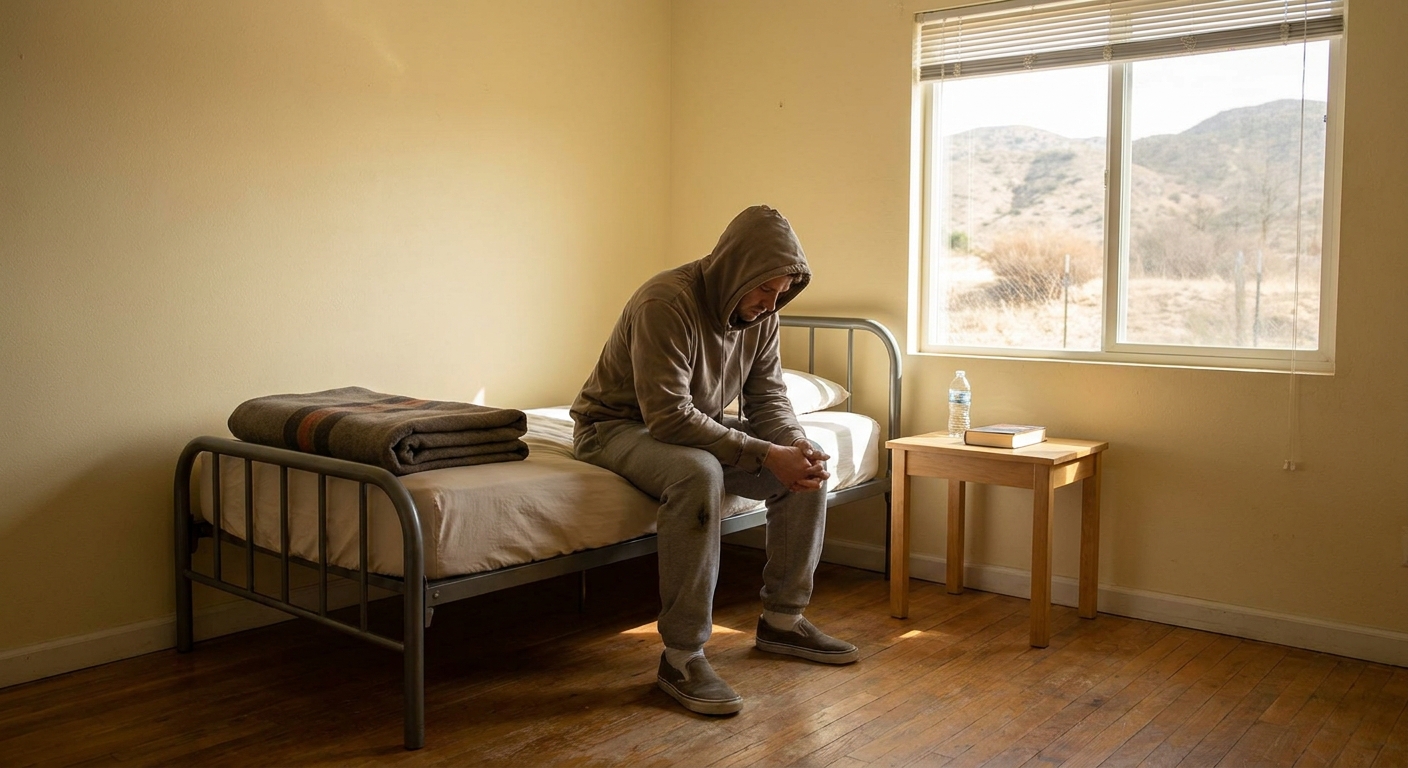
A 2022 Bureau of Justice Statistics study tracking 68,000 people released from state prisons found that substance use relapse is one of the strongest predictors of reincarceration within three years. Staying sober after prison is not about willpower alone. It requires a specific plan, executed in a specific order, starting before you leave and continuing through the first twelve months of reentry.
What you’re up against (and why the plan matters)
The numbers are stark. That same Bureau of Justice Statistics study found that nearly two-thirds of people released from state prison were rearrested within three years, and substance use was a leading driver. What this means in practice: the period between release and 90 days out is the window where the plan either holds or breaks down.
This guide is built for that window and the months that follow. It covers the first 72 hours, the first week, and the ongoing structure that makes sobriety sustainable. Whether you’re reading this days before release, the day you get out, or weeks into reentry, every step here is actionable today.
Before you start: what you need in place
A 2021 Urban Institute reentry study of 1,400 formerly incarcerated adults found that gaps in four baseline areas, specifically ID, housing, a support contact, and a clear understanding of supervision conditions, doubled the risk of relapse in the first 90 days. These aren’t soft recommendations. They’re the foundation every other step depends on.
Get your state-issued ID or driver’s license in hand before anything else. California’s DMV offers expedited services for people returning from incarceration, and many reentry programs can help you navigate that process. Confirm where you’re sleeping on your first night and your first week. Identify one person who knows you’re out and who you can call. Then read your supervision paperwork before you make any treatment decisions, because your parole or probation conditions determine what your options actually are.
Know your supervision requirements first
Parole and probation conditions are not bureaucratic fine print. They directly shape your treatment options. Random drug testing schedules, mandatory program enrollment, travel restrictions, curfews, and geographic limitations all affect which programs you can attend and how. Read every condition before you call a treatment center. Know your reporting schedule. Know whether you need prior approval before enrolling in a program. Know whether your conditions already specify a program type or provider.
If anything in your supervision paperwork is unclear, contact your parole or probation officer before your first appointment, not after. Showing up to a program that conflicts with a supervision condition creates problems that would otherwise not exist.
Confirm your insurance or coverage before day one
Most people released from California prisons are automatically eligible for Medi-Cal upon release. In many counties, enrollment is initiated before release through in-reach programs. But coverage lapses during incarceration are common, and many people don’t discover the gap until they’re sitting in front of an intake coordinator.
Before your first appointment at any treatment program, call Covered California or your county’s social services office to confirm your coverage status. If you’re in Riverside County, the Department of Public Social Services can confirm eligibility quickly. Medi-Cal covers substance use treatment including Intensive Outpatient Programs, residential care, and medication-assisted treatment. Don’t skip this step and assume it’s handled. Confirming it takes one phone call and prevents a significant delay in getting into care.
Step 1: get through the first 72 hours with a written plan
A 2020 National Institute on Drug Abuse study following 900 people post-release found that the first three days after release carry the highest overdose risk of any point in the reentry window. The mechanism is tolerance: after months or years of incarceration, your body’s tolerance has dropped dramatically. A dose that felt manageable before is now potentially fatal.
Write down where you will be, hour by hour, for the first 72 hours. This is not an exercise in optimism. It’s a concrete document that removes the question “what do I do now” in moments when that question is dangerous.
Identify one person who knows your plan
Not a group. Not a hotline. One named person who has your written schedule, knows your release date, and has explicit permission to check in on you during those first three days. This person can be a family member, a sponsor, a case manager, or a peer support specialist. The specific relationship matters less than the specificity of the arrangement. They know when to expect to hear from you, and they know what to do if they don’t.
Research from the RAND Corporation consistently shows that named accountability, meaning a specific person with a specific role, outperforms general support networks in the early reentry window. Give someone that role before you need them.
Remove access to substances before you sleep that first night
Audit your living environment on day one. Who lives there? What’s stored there? Are there people in that space who use? These are conversations to have before you arrive, not after. If someone in the home uses and has no intention of stopping, that’s information you need to factor into your housing decision before your first night, not your third.
If the home isn’t safe to return to, a sober living environment is a better option than white-knuckling it through an unsafe situation. That decision is covered in Step 6.
Step 2: enter a structured treatment program within the first week
Research published in the Journal of Substance Abuse Treatment in 2019, analyzing outcomes for 2,300 returning citizens, found that individuals who enrolled in a formal treatment program within seven days of release were 40% less likely to relapse at the six-month mark than those who waited. Seven days is the window. Every day of delay erodes that protection.
The substance abuse treatment options available to people on parole vary in structure and intensity. Knowing the difference before you call an intake line saves time and gets you into the right level of care faster.
Know the difference between outpatient and residential options
An Intensive Outpatient Program (IOP) typically involves nine or more hours of structured treatment per week across three to five days. You live at home or in sober living and attend sessions on a schedule. This is the right fit for people with stable housing and a relatively stable support environment who need to maintain work or family responsibilities.
A Partial Hospitalization Program (PHP) is more intensive, usually five to six hours of programming per day, and is appropriate when someone needs more structure than IOP provides but doesn’t require 24-hour residential care. Residential treatment, sometimes called inpatient treatment, involves living at the facility full-time and is the right level of care when the home environment is unsafe, when detox is needed, or when previous attempts at outpatient care haven’t held.
Match the level of care to your actual situation, not the least disruptive option.
How to enroll if you have a court order or parole condition
If your participation in treatment is legally mandated, bring your supervision paperwork to your intake appointment. Programs that work with returning citizens are familiar with court-ordered enrollment and know exactly what documentation your probation or parole officer needs. Ask the intake coordinator at your first call what attendance verification looks like and how it gets reported. Get that process clear before your first session, not after a missed report date.
Programs connected to reentry-specific services, like those serving Riverside County’s reentry population, are built to navigate exactly these requirements and can often communicate directly with supervision staff when needed.
Step 3: build a daily structure that crowds out risk
A 2023 University of California, San Francisco study tracking 600 adults in early recovery found that unstructured time, defined as more than four consecutive hours without a scheduled activity, was the single strongest situational predictor of relapse. The danger isn’t cravings alone. It’s the empty space where a craving becomes a decision becomes an action.
Map your high-risk hours first
Look at your history honestly. For most people in early recovery, the high-risk window falls in the late afternoon and evening, roughly 4 p.m. to 9 p.m. Those hours need to be filled with specific, scheduled activity before they arrive. Not “I’ll find something to do.” A named activity, at a named time, in a named place.
Identify your two or three highest-risk daily windows and put something concrete into each one before the week starts. A meeting, a gym session, a meal with a sober contact, a call with your accountability person. The specifics matter less than the fact that the slot is filled.
Build the simplest version of a recovery routine
Start with the basics: a consistent wake time, morning and evening check-ins with your accountability contact, treatment sessions or meetings, meals, and a sleep time. One week of this structure is enough to feel its stabilizing effect. You’re not aiming for a perfect schedule. You’re aiming for a predictable day that leaves no four-hour gaps.
The simplest version works. Add complexity later when the foundation is solid.
Step 4: reconnect with support networks strategically
A 2021 RAND Corporation study of 3,100 people in reentry found that social connection to at least one pro-recovery peer reduced relapse rates by 35% over 12 months. The word “strategically” carries real weight here. Not every relationship from before incarceration supports sobriety. Some of them actively undermine it.
Find a peer support specialist or recovery mentor
A peer support specialist is someone with lived experience of addiction and recovery, often also with reentry experience, who is trained to provide structured support. This is different from a sponsor or a friend. It’s a defined relationship with a defined purpose, and research consistently shows it’s more protective than group meetings alone in the first 90 days.
Find one through your county’s behavioral health department, through your treatment program, or through a reentry-specific program. In Riverside County, the STOP Reentry Program connects participants to counselors and peer support with direct reentry experience who understand what coming back actually takes, not just what the textbook says it takes.
Cut contact with high-risk relationships, and how to do it
Some relationships from before incarceration are tied directly to past use. Continuing contact with those people in early recovery is not a test of your strength. It’s an unnecessary risk. The script doesn’t need to be elaborate: “I’m focused on my recovery right now and need to create some distance. I wish you well.” Short, direct, and final.
For family members who are still using, the approach requires more nuance. You can maintain a relationship without sharing physical space during high-risk hours. Set specific, limited terms for contact rather than cutting off entirely. Protect your recovery without severing every family connection. For family members on the other side of this situation, the guide on supporting a loved one coming home covers how to help without enabling.
Step 5: address mental health and trauma alongside substance use
SAMHSA’s 2022 national survey found that 65% of incarcerated adults with a substance use disorder also met criteria for at least one co-occurring mental health condition. Treating only the addiction while leaving the underlying condition unaddressed is the move that leads back to relapse. This is not a secondary issue. It’s the issue.
Get a dual diagnosis screening in your first month
A dual diagnosis or co-occurring disorder screening is a structured clinical assessment that identifies whether a mental health condition, such as depression, anxiety, PTSD, or bipolar disorder, is present alongside substance use. Any licensed treatment program can administer this, and county behavioral health offices can refer you for one if your treatment program doesn’t offer it directly. Request it explicitly in your first month, because it shapes the entire treatment approach going forward.
Understand how trauma from incarceration itself affects recovery
Incarceration produces specific psychological effects that create relapse risk even when pre-existing trauma is being treated. Hypervigilance, difficulty trusting others, difficulty tolerating unstructured time, and a conditioned response to institutional routines all persist after release and all create vulnerability. These aren’t character flaws. They’re predictable outcomes of the incarceration environment.
Two evidence-based approaches address this directly. Seeking Safety is a present-focused treatment that addresses trauma and substance use simultaneously. Cognitive Processing Therapy helps people work through distorted thought patterns that developed during incarceration. Ask your treatment provider whether either of these is part of your program. If it isn’t, ask why.
Step 6: stabilize housing and employment without sacrificing sobriety
A 2022 study in Health & Justice journal tracking 800 returning citizens in California found that unstable housing in the first six months of release tripled the likelihood of relapse. The pressure to secure housing and income quickly is real. So is the risk of making choices under that pressure that compromise your recovery.
Use sober living as a bridge if home isn’t safe
A sober living home is a structured, substance-free residence where all residents are in recovery. Residents maintain their own treatment schedules, employment, and responsibilities, but the shared environment creates accountability that a solo living situation may not. In Riverside County and the broader Inland Empire, sober living homes are available at various price points, and some accept Medi-Cal or operate on sliding-scale fees.
If the home you’d return to has active substance use, unresolved conflict, or conditions that create relapse risk, a sober living environment is not a step backward. It’s the smarter bridge to stable independent living.
Find work that fits your recovery schedule
Employment is protective for recovery when it doesn’t create schedule conflicts that force you to choose between work and treatment. When looking for jobs, prioritize positions where your treatment appointments, meeting schedule, and supervision check-ins can be accommodated. This often means being direct with an employer early rather than managing it around the edges.
California’s Fair Chance Act (AB 1008) restricts when and how employers can ask about criminal history. Employers cannot ask about your record until a conditional offer has been made. Know this before you start applying. You don’t have to disclose your record on an initial application, and an employer cannot rescind an offer based solely on a record without going through a specific individualized assessment process.
Step 7: handle cravings with a repeatable response plan
A 2021 Yale School of Medicine study tracking craving patterns in 450 adults over six months of recovery found that cravings peak in under 20 minutes and pass without use if a behavioral interruption is introduced within the first five minutes. The problem isn’t that cravings happen. The problem is having no plan when one arrives.
Build a three-step craving response you can use anywhere
Name the trigger. Contact your accountability person. Change your physical location. Those three steps, in that order, are your craving response. The mechanism behind the third step is concrete: physically relocating disrupts the environmental cues that are feeding the craving. You are not trying to think your way through it. You’re removing yourself from the situation that’s triggering it.
Practice this sequence before you need it so it becomes automatic. Write it down. Put it in your phone. The goal is zero thinking in the moment, just execution.
Know when a craving signals you need more support
A craving that persists, that comes back multiple times a day, or that you find yourself bargaining with is not a willpower problem. It’s a signal that the current level of care isn’t enough. The right response is to step up to a higher level of care, not to endure. Contact your treatment provider and describe what’s happening. That’s what they’re there for.
Step 8: prepare for setbacks without letting them become relapse
A 2019 study in Drug and Alcohol Dependence following 1,200 people in long-term recovery found that 60% experienced at least one slip in the first year, but those who had a pre-planned response to a slip were three times more likely to return to full sobriety within 30 days than those who had no plan. A setback is not the end. What you do in the next 24 hours is what determines whether it becomes one.
Know the difference between a slip and a relapse
A slip is a single use event. A relapse is a return to the pattern of problematic use. These are clinically and practically distinct, and how you respond in the hours after a slip determines which one it becomes. Shame, isolation, and hiding the slip from your treatment team are the responses that turn a slip into a relapse. Immediate transparency and re-engagement are the responses that don’t.
Use the 24-Hour rule
Within 24 hours of a slip, contact your treatment provider or counselor directly, not just a peer. Research on relapse response consistently shows that professional re-engagement in that window is more effective at preventing full relapse than peer support alone. Your counselor can assess whether a step up in care is needed and help you understand what triggered the slip so the plan can be adjusted.
This is not a confession. It’s a clinical conversation. Treatment providers expect this to happen and are prepared for it.
Troubleshooting: when the standard path isn’t working
What to do if your treatment program isn’t helping
If you’ve attended a program for two or more weeks and feel no therapeutic benefit, that’s information. Not every program is the right fit for every person, and reentry-specific programming differs meaningfully from general outpatient treatment. Contact your county’s behavioral health department and ask for a re-referral. Request a program with experience serving people returning from incarceration. The CDCR STOP Program is one structured option worth understanding, as it connects participants to reentry-focused counseling and life skills programming designed for this population specifically.
What to do if supervision requirements are blocking treatment access
If a parole or probation condition is creating a direct conflict with treatment enrollment, document the conflict in writing and bring it to your parole or probation officer immediately. Request a modification or clarification. Most supervision conditions are designed to support treatment, not block it, and officers can work with treatment providers to resolve scheduling conflicts. Your treatment program’s intake coordinator can also communicate with supervision staff directly if given permission to do so.
What to do if your home environment is a relapse risk
Contact a sober living placement service or your treatment program’s case manager and request an urgent referral. In Riverside County, options exist at various income levels including Medi-Cal-eligible placements. Do not wait until a relapse occurs to act on a housing situation you already know is unsafe.
What to do if mental health symptoms are getting worse, not better
Contact your treatment provider and ask explicitly for a psychiatric evaluation, not just a counseling adjustment. Worsening anxiety, depression, or intrusive thoughts during early recovery are not signs that recovery isn’t working. They’re signs that the mental health component of treatment needs more direct clinical attention. A medication evaluation from a psychiatrist may be part of the answer.
Your move this week
Call and schedule an intake appointment at a licensed treatment program. When you call, have three things ready: your ID, your insurance information or Medi-Cal status, and your supervision paperwork. Tell the person who answers that you’re recently released and need an intake appointment as soon as possible. That’s the complete script. Most programs can schedule an intake within 48 to 72 hours.
Every step in this plan flows from that one call. Make it today.
Frequently asked questions
How soon after release should I enter a treatment program?
Within seven days. A 2019 study in the Journal of Substance Abuse Treatment found that people who enrolled in formal treatment within a week of release were 40% less likely to relapse at the six-month mark. If you’re waiting for paperwork, a referral, or insurance confirmation to come through, call a program today and schedule the intake appointment in advance so you’re not starting from zero on the day you’re released.
Does medi-cal cover substance use treatment after incarceration?
Yes. Medi-Cal covers a range of substance use treatment services in California, including Intensive Outpatient Programs, residential treatment, and medication-assisted treatment. Most people released from California state prisons are eligible for Medi-Cal upon release. Call your county’s social services office or Covered California to confirm your coverage status before your first intake appointment.
What if i’m required by a court or parole condition to attend a specific program?
Bring your supervision paperwork to every intake appointment. Programs experienced in reentry are familiar with court-ordered enrollment and know how to provide the attendance documentation your probation or parole officer needs. If a supervision condition is creating a conflict with treatment access, document it and bring it to your officer directly. Supervision conditions are generally intended to support treatment participation, not obstruct it.
What’s the difference between a peer support specialist and a sponsor?
A sponsor is a volunteer recovery support role, typically within a 12-step program, with no formal training requirement. A peer support specialist is a trained, often certified professional with lived experience of addiction and recovery who provides structured support within a clinical or reentry framework. Both have value, but in the first 90 days after release, research supports the peer support specialist relationship as more consistently protective due to its structured and accountable nature.
Is sober living required, or can I return directly home?
Sober living is not universally required. If your home environment is stable, substance-free, and supportive of your recovery, returning home is a reasonable choice. If the home has active substance use, unresolved conflict, or other risk factors, sober living is the safer option. The decision should be based on an honest assessment of what you’re returning to, not on what’s most convenient or expected.
How do I handle family members who are still using?
You can maintain a relationship without sharing physical space during high-risk hours. Set specific, limited terms for contact rather than an all-or-nothing approach. Be direct about what you need: “I can’t be around substances right now, and I need our time together to happen in a way that protects my recovery.” Family members who want to support you will work with that. For guidance on how a family member can actively help without creating risk, the article on supporting a loved one coming home covers that dynamic in detail.